How Should SMEs Prepare Their Governance and Sustainable IT Priorities for 2027?
23 November 2026
As organisations prepare for 2027, it can be difficult to know where to focus.
Governance requirements continue to evolve. Businesses are increasingly dependent on technology and suppliers. AI adoption is accelerating. Customers are asking for greater assurance. Sustainability is becoming more closely connected with procurement and supply-chain expectations.
For SMEs, that can quickly create a long list of potential priorities.
But effective preparation does not mean trying to solve everything at once.
It means understanding where the organisation is today, identifying what matters most and deciding what should happen next.
Start with the business
Before creating new governance initiatives, consider what the organisation actually wants to achieve in 2027.
Are you targeting larger customers?
Introducing new technology?
Expanding the use of AI?
Changing important suppliers?
Refreshing parts of the technology estate?
Responding to new customer or procurement requirements?
These priorities provide the context for deciding where governance needs to evolve.
Look across the organisation
Governance, Operational Resilience, AI and Sustainable IT can appear to be separate subjects.
In practice, they often share common foundations.
Clear ownership.
Risk management.
Reliable information.
Supplier management.
Appropriate policies and controls.
Evidence.
Review.
Continual improvement.
Looking across these areas can help organisations identify where existing governance can be strengthened rather than creating another separate process for every new requirement.
Include technology and sustainability
Technology planning should form part of the same conversation.
Better visibility of the technology estate can help organisations make more informed decisions about cost, utilisation, retention, procurement and replacement.
Environmental information adds another dimension.
Could suitable assets remain in service for longer?
Could equipment be reused or reassigned?
Could refurbished technology provide an appropriate alternative?
Could more energy-efficient technology reduce operating costs when replacement is genuinely required?
Sustainable IT becomes much more practical when environmental information is considered alongside cost, performance, security, resilience and business need.
Think about what you may need to demonstrate
For SMEs supplying larger organisations or the public sector, preparation also has a commercial dimension.
Customers and procurement teams may ask for evidence around governance, security, resilience, AI or sustainability.
The exact requirements will differ between organisations and sectors.
But it is useful to understand where credible evidence already exists and where the organisation might struggle to demonstrate its approach.
That gives you time to address gaps before they become barriers to an opportunity.
Focus on what matters most
A readiness review can identify many possible improvements.
They will not all be equally important.
Some may address significant business risks.
Others may support an important customer requirement.
Some could reduce unnecessary cost.
Others may improve resilience or strengthen environmental performance.
The objective is not to create the longest possible action list.
It is to understand where attention will create the greatest value.
Preparation is a starting point
You do not need to complete every governance, resilience, AI or sustainability improvement before January.
But you should enter 2027 with a clearer understanding of where you are today and where attention is needed.
That means knowing:
What matters to the business.
Where significant risks or dependencies exist.
Where governance needs to evolve.
What customers may expect you to demonstrate.
Where technology decisions could create financial and environmental value.
And where action should begin.
Want the full framework?
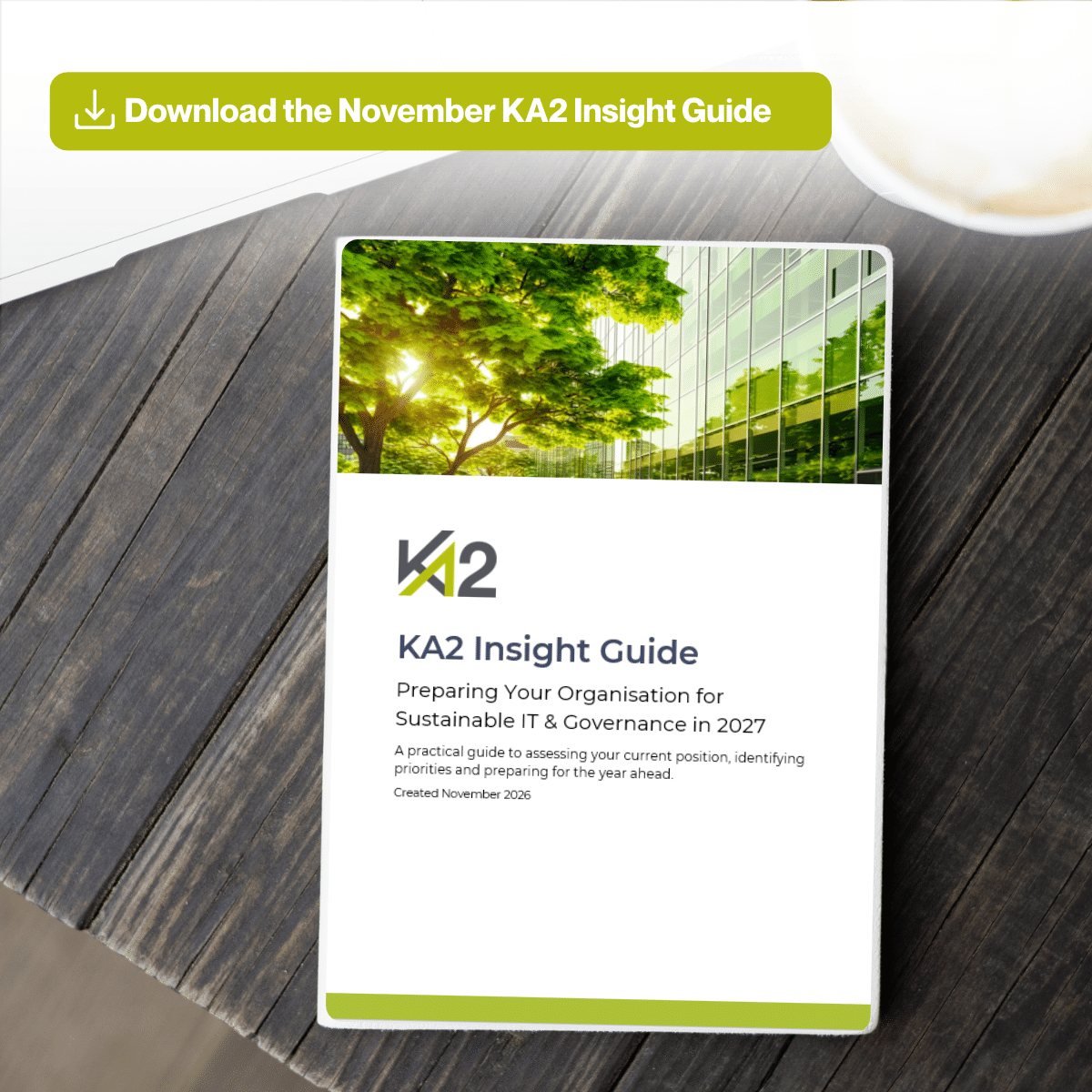
Our November KA2 Insight Guide, Preparing Your Organisation for Sustainable IT & Governance in 2027, takes this further with a practical framework for assessing your current position and translating the findings into clear priorities for the year ahead.
It covers business priorities, governance, Operational Resilience, AI Governance, Sustainable IT, customer and supply-chain expectations, prioritising gaps, building an action plan and establishing an ongoing review cycle.
It also includes a practical 2027 Readiness Checklist covering the key questions organisations can use to assess where they are today.
Download the full November Insight Guide → HERE.

