Navigating the Cyber Security Framework Landscape: CIS, NIST, ISO 27001, COBIT, PCI-DSS & GDPR
15 December 2025
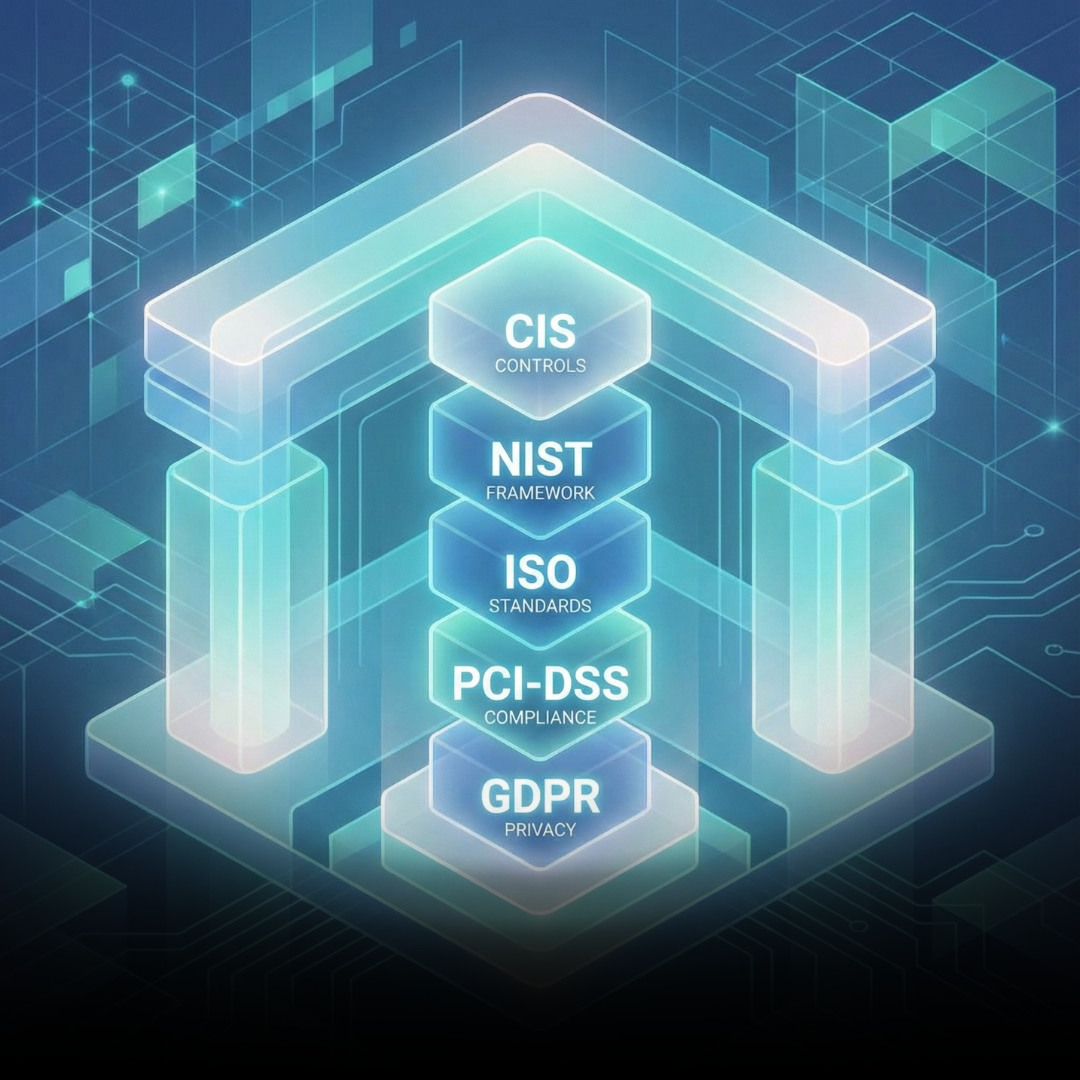
Why Frameworks Matter More Than Ever
The cyber security landscape today is more volatile, interconnected, and regulated than ever before. Global research highlights this pressure: 69% of organisations report increased cyber attacks in the last 12 months, and 83% of CISOs feel they face “framework overload”, with too many standards, unclear overlaps, and increasing regulatory demands.
Frameworks provide a solution to this complexity. They offer a structured, repeatable approach to building security, a common language for security teams, IT, the board, and auditors, and evidence of good governance for regulators, customers, and insurers. Crucially, they facilitate defensible decision-making, which is essential during post-incident investigations. However, these frameworks vary widely in purpose, scope, maturity expectations, and compliance requirements. This guide breaks down the major standards – CIS, NIST CSF, ISO 27001, COBIT, PCI-DSS, and GDPR – to show how they fit together into a coherent security strategy.
Understanding Each Framework in Depth
CIS Controls (v8): The Actionable Baseline
The Centre for Internet Security (CIS) Controls are designed for fast, high-impact uplift. They focus on actionable, technical measures and are ideal for SMEs and IT teams. Built on 18 prioritised controls, they cover foundational areas such as asset inventory, vulnerability management, secure configuration, access controls, and incident response. Organisations choose CIS because it is quick to adopt, has a strong technical focus, and demonstrably reduces risk. It often serves as a “baseline hardening” layer, providing the “What to implement first” guidance. Many organisations wisely combine CIS for technical controls with ISO or NIST for overarching governance.
NIST Cyber security Framework (CSF 2.0): The Risk-Based Lifecycle
The NIST CSF is centred on a risk-based lifecycle model, making it highly flexible and scalable for organisations of all sizes. It structures security around five core functions: IDENTIFY → PROTECT → DETECT → RESPOND → RECOVER. Organisations value NIST for its flexibility and customisability, strong focus on risk, and respect across various sectors. While NIST does not offer a formal certification, it guides organisations to define security outcomes based on risk appetite. A common strategy is blending NIST’s lifecycle structure with CIS’s technical control catalogue.
ISO 27001: The Governance and Certification Standard
ISO 27001:2022 focuses on governance, a management system, and certification. It is the go-to standard for enterprises, regulated industries, and anyone needing external assurance. It provides the blueprint for an Information Security Management System (ISMS), ensuring security is anchored into business governance. This framework covers policies and roles, risk treatment, continuous improvement, supplier risk, and legal/regulatory compliance. Its status as internationally recognised and often required for many tenders makes it a powerful demonstration of maturity and due diligence.
COBIT 2019: Assuring the Board
COBIT sits at the highest governance layer, often above frameworks such as ISO and NIST. Its focus is the governance of enterprise IT, making it ideal for board-level assurance in large enterprises. While ISO 27001 governs information security, COBIT governs all of IT, including security. It focuses on business alignment, value delivery, and risk governance, enabling boards to measure if IT is delivering value and managing risk.
PCI-DSS (v4.0): Mandatory Payment Compliance
PCI-DSS is unique as a mandatory compliance regime for any business that stores, processes, or transmits cardholder data. It is data-specific (cardholder data only) and highly technically detailed and prescriptive. Requirements include network segmentation, encryption, and access control. It should be integrated into your overall security strategy, not treated as an isolated silo.
GDPR: The Regulatory Driver for Security
While not a dedicated cyber security framework, GDPR (General Data Protection Regulation) for EU/UK data has major security expectations. It mandates “appropriate technical and organisational measures”, breach notification, and processor accountability. The ISO 27001 annex controls often map directly to GDPR compliance needs.
Choosing the Right Model
Selecting a framework requires key considerations based on your organisation’s needs:
| If your priority is… | Use… | Why |
| Quick uplift | CIS Controls | High impact fast |
| Governance & Assurance | ISO 27001 | Formal ISMS |
| Flexible, Risk-based Approach | NIST CSF | Flexible + risk-based |
| Board-level Alignment | COBIT | Enterprise governance |
| Payment Compliance | PCI-DSS | Mandatory |
| Data Protection Compliance | GDPR + ISO | Strong mapping |
The Integration Roadmap
Many organisations fall into common pitfalls, such as treating frameworks as simple checklists or choosing one based on trends. The most successful strategies integrate frameworks into a coherent, governance-backed approach.
The ideal strategy involves:
- Assessing your current maturity against NIST or ISO as a baseline.
- Defining business and regulatory drivers to set clear expectations.
- Choosing a primary framework (usually ISO or NIST) as the strategic “operating model”.
- Adding CIS for technical specificity, giving teams clear implementation guidance.
- Mapping frameworks together to avoid duplication and reduce audit fatigue.
- Implementing continuous assurance so security is monitored throughout the year, not just annually.
KA2 Approach
If you are struggling to navigate CIS, NIST, ISO, PCI-DSS or GDPR, we can help. Our Security Assurance Services provide the expertise to move you from framework confusion to strategic clarity:
- Framework alignment and maturity assessments
- ISO 27001 implementation
- CIS and NIST control uplift
- Cross-framework mapping to avoid duplication
- Technical audits and gap analysis
- Continuous assurance programmes
- Third-party risk strategy and governance
Let us identify the right model for your organisation and build a tailored roadmap.
Conclusion
Explore your Security Maturity journey with KA2. Schedule a short, no-obligation session with our consultants to discuss your security frameworks, governance, or third-party risk priorities.

