AI in Cyber Security: Opportunities, Risks & the Growing Challenge of Shadow AI
15 December 2025
The Dual-Edged Sword of Artificial Intelligence
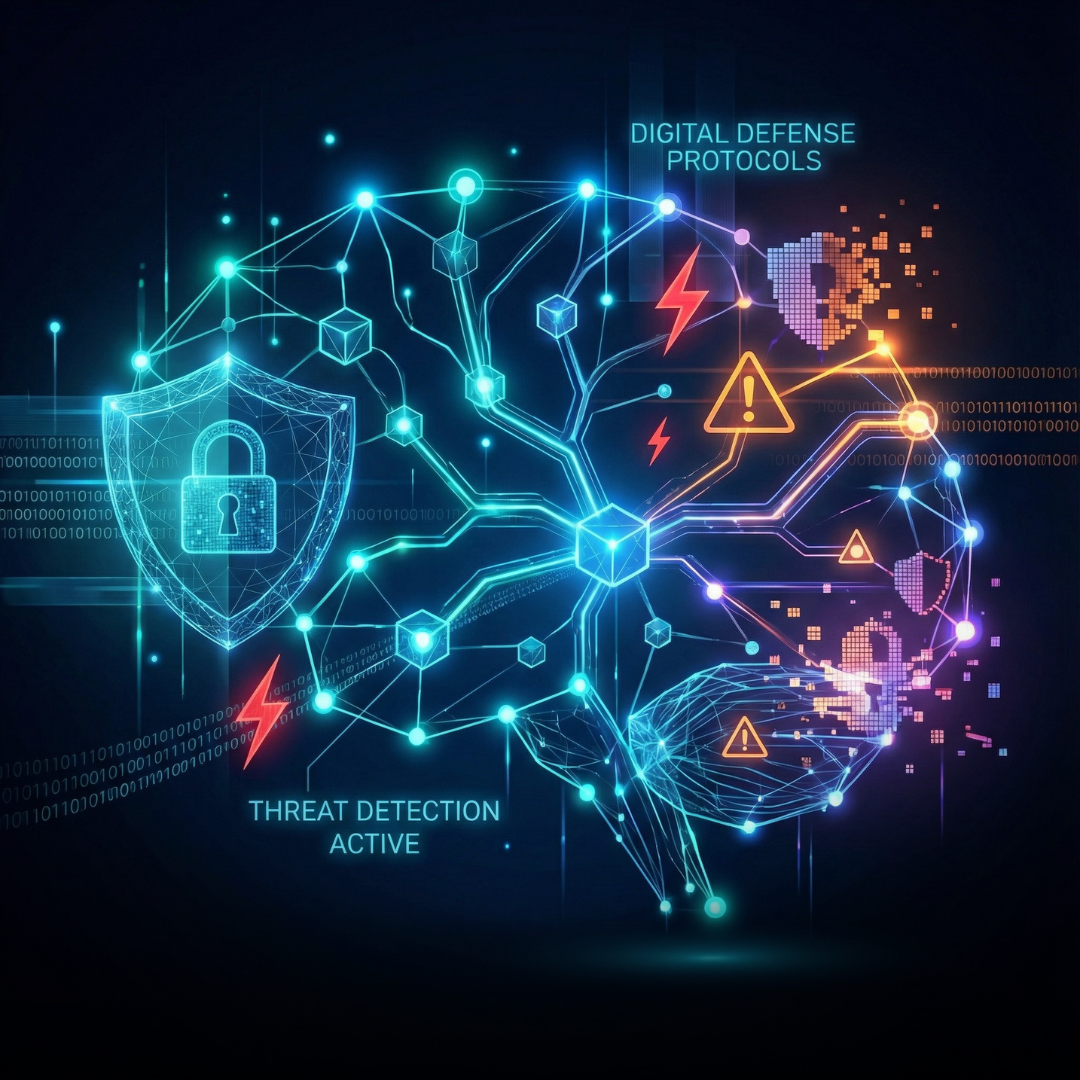
Artificial Intelligence has become the most disruptive force in modern cyber security, simultaneously accelerating innovation and widening the threat landscape. The impact is staggering: 85% of cyber leaders say AI has increased attack speed and sophistication. This transformation is playing out in three major ways: attackers are using AI to scale and sharpen their methods, defenders are using AI to accelerate detection and response, and businesses are exposed to new risks through ungoverned AI adoption, known as Shadow AI.
How Attackers Are Using AI: A New Class of Threats
AI acts as a force multiplier for cyber criminals. Attackers no longer need deep technical skills; they just need an internet connection and an LLM prompt.
AI-Enhanced Phishing & Social Engineering: Large language models generate flawless phishing emails and multilingual content at speed. AI phishing tools have shown a 40% increase in success rate compared to human-written attempts.
- Deepfakes & Voice Cloning: Attackers can generate executive voice instructions (CEO fraud) and video deepfakes for social engineering, with one documented case costing a company $25 million.
- Automated Exploitation: AI can scan at scale for misconfigurations, exposed APIs, and exploitable endpoints, accelerating vulnerability discovery.
- Malware Evolution: AI helps create polymorphic malware and generate obfuscation code to evade signature-based tools.
How Defenders Are Fighting Back: Automation vs Automation
The future of cyber is rapidly becoming AI vs AI. Defenders are leveraging AI for powerful capabilities that spot patterns humans miss.
- Threat Detection & Anomaly Analysis: AI excels at spotting unusual login behaviour, lateral movement indicators, and suspicious API activity.
- SOC Augmentation: AI can triage alerts, reduce false positives, and recommend response actions. This reduces burnout and accelerates investigation time.
- Automated Response: AI can be used to isolate endpoints, revoke credentials, and block malicious IPs.
- Secure Coding Support: AI tools assist developers in detecting insecure patterns and suggesting safer code.
The Hidden Risk: The Rise of Shadow AI
Shadow AI refers to employees using unapproved AI tools like public chatbots, AI-powered browser plugins, or AI code assistants. Nearly 50% of staff admit to using AI without approval, creating major, unmonitored risks.
Shadow AI is today what Shadow IT was a decade ago, but with far greater consequences. Risks include:
- Sensitive Data Leakage: Employees may paste customer data, source code, or internal documents into public AI tools. This data may be used to train models.
- Compliance Breaches: Employees rely on AI for legal advice or financial modelling, and errors create compliance or regulatory issues.
- Unassessed Third-Party Risk: Unapproved AI SaaS adoption means unknown data storage locations and a lack of audit trail.
The AI Governance Imperative
To harness AI safely, governance must ensure it is safe, ethical, compliant, and secure. An AI Governance Framework addresses policies, approved use cases, risk assessments, and Shadow AI detection & controls.
Regulators are increasing pressure globally (e.g., the EU AI Act, NIST AI Risk Management Framework, and emerging ISO/IEC 42001). Organisations must define clear “do not enter into AI” data types and integrate AI risk assessment into procurement.
How We Support AI Governance
We help organisations govern AI before it governs them. Our Security Assurance Services provide structured support to integrate AI into your risk and security strategy:
- AI Risk Assessments: We evaluate risks, data flows, model behaviour, and misuse scenarios.
- AI Governance Frameworks: We help design and implement policies, acceptable-use standards, access controls, and monitoring protocols.
- Shadow AI Identification & Mitigation: We provide discovery, analysis, and mitigation plans.
- Secure-by-Design AI Adoption: We embed security early in AI projects and provide technical hardening (MFA, encryption, logging).
- Staff Training & Incident Response: We provide training on safe AI usage and support incident handling for AI misuse.
Conclusion
AI brings unprecedented risk without governance, oversight, and secure adoption. Our Security Assurance Services help you build AI governance frameworks, assess AI risk and compliance, identify and control Shadow AI, and train staff on secure AI usage.

